
Designed while at BrainStation
Breakroom is a social connectivity platform that brings remote teams together through fun games and icebreakers.
Year
2020 (3 months)
Contribution
End to end UX and UI, Visual design, Prototype, Research
PROBLEM
As companies see a boom in remote working (both related to COVID-19 and also general trends in the coming years), newly remote workers are struggling to adapt to their new workplace reality.
According to an 18 month qualitative study, data shows that remote workers often view virtuality as ‘a barrier’ to forming friendships with their colleagues. Data suggests new remote workers are twice as likely to feel disengaged from their teams and workplaces than experienced ones. The reduction in collaboration, motivation, profitability and productivity associated with disengagement could cost the economy billions of dollars.
Project Goals
Understand remote employee’s perception of work from home
Whether there was a desire to get to know their coworkers better and how socialization has changed in a virtual workplace.
Foster a better remote work culture by helping remote employees build better relationships with their coworkers.
Discover
CRITICAL RESEARCH INSIGHTS
Majority of the respondents felt it was important to have fun with their coworkers. Almost 40% of the respondents felt their company does not do anything to help them get to know their coworkers whereas 60% felt their company could do much better.

THEMES
Informal face-to-face conversations and chats at the workplace.
People longed to experience the face to face, informal workplace interactions. Be it grabbing lunch, walking down the hallway together, getting coffee, etc. Those were opportunities for informal conversations that helped ease out relationships with employees and in turn made them feel more confident at work.
Scheduling conflicts were blockers to socializing.
While managers did want to take time out to build a personal connect with their teams, especially amidst COVID-19 concerns, they often experienced scheduling conflicts when working from home and found it tedious and time consuming to come up with activities.
Open to games and icebreakers.
People enjoyed engaging in quick games that allowed one to shed their inhibitions, break the ice and understand their coworkers personality.
How might we help remote employees socialise with their coworkers virtually in order to feel more engaged at work?
Define
USER PERSONA
Based on the insights from interviewee’s, I arrived at the following persona as our ideal target user for our product.


EXPERIENCE MAP
Based on the personas and insights from research, the experience map revealed two areas of opportunity.
Remote office socials.
More personalized 1:1 with team with selection of icebreakers to save time.

USER STORIES
According to Arjun and Lena’s set of goals, a set of user stories were created under 5 epics in order to arrive at the main purpose and function of the product. Taking into account the main value proposition, the following epic (Social) and user stories were used to create the minimum viable product.

TASK FLOW

Ideate
CONCEPT SKETCHES
The initial sketches focussed on the creation of virtual rooms to bridge the gap between social interacting online and in the office. This led to the idea of ‘separate rooms’ for particular activities. Such as a lounge for coffee chats, a gym for online fitness classes, and a boardroom for meetings.
However, after peer feedback, it seemed the purpose of the app was getting lost and there was a need to simplify and focus on the social aspect.
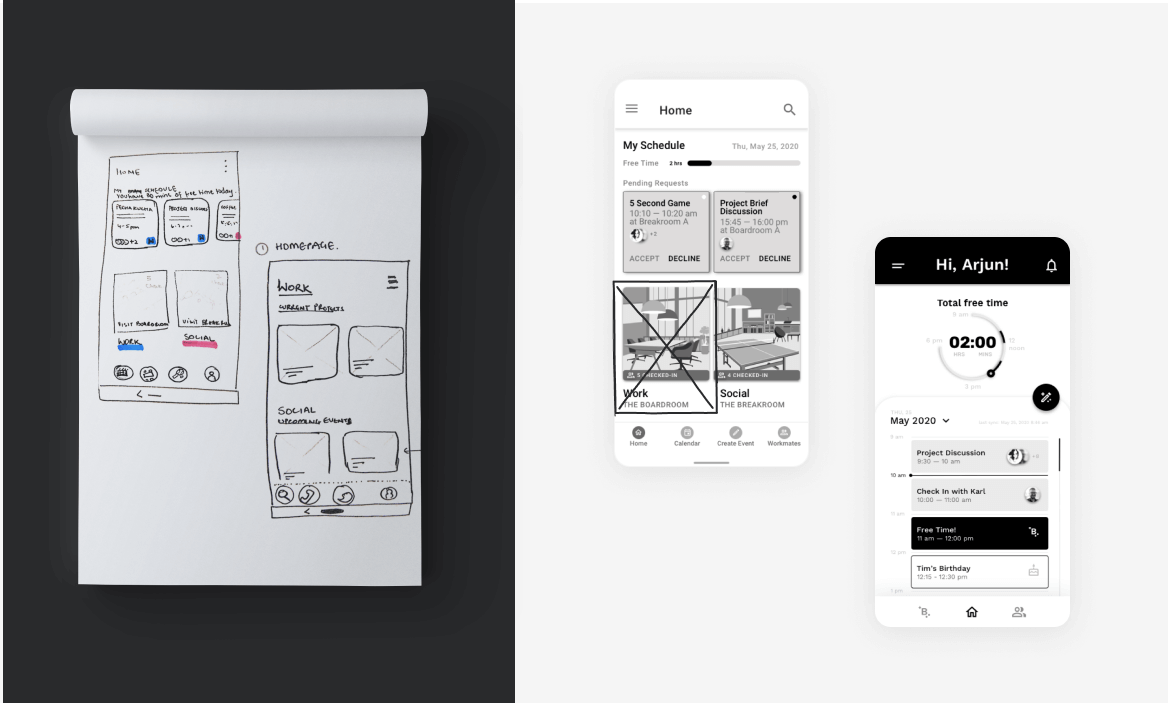
USER TEST INSIGHTS
Based on Steven Krug’s usability testing script, I carried out ten usability tests in total which included several iterations to arrive at the latest version of the Breakroom. I provided the users with a scenario and 5 tasks to complete, while I recorded their interaction with the prototype. The Usability Testing & Session output plan for Round 1 and Round 2 are available for further details.
Results
34%
Increase in engagement with tools (Track and Find a Rate) since deploying the new navigation.Future iterations
Remove duplicated links and pages in the navigation architecture, and revisit labellingStrengthen overview page templates to remove Level 4 pages, redirecting traffic to overview pages and decreasing bounce rates from deep navigation levels